IMSI catchers, also known as rogue base stations, cell-site simulators, or by their most infamous commercial brand name "Stingray," are one of the most persistent and evolving threats to mobile privacy and security. These devices exploit fundamental weaknesses in the way mobile devices connect to cellular networks — specifically the priority given to signal strength over authentication in legacy protocols. From law enforcement surveillance to nation-state espionage, IMSI catchers represent the physical-layer attack vector that no amount of software patching can fully eliminate without fundamentally redesigning how cellular networks operate.
The threat is not theoretical. IMSI catchers have been documented in active use by law enforcement agencies in over 75 countries, deployed in conflict zones for military intelligence gathering, and detected near embassies and government buildings worldwide. In 2018, the U.S. Department of Homeland Security confirmed the presence of unauthorized cell-site simulators operating near the White House and Senate buildings. Understanding how these devices work — and how they can be detected and mitigated — is essential knowledge for any telecom security professional.
This article provides a comprehensive technical analysis spanning from 2G GSM through 5G network security architecture, examining the specific protocol weaknesses exploited, the evolution of both attack and detection capabilities, and the defensive countermeasures available to operators and security-conscious organizations. For the signaling-layer attacks that often complement IMSI catching (like SS7 location tracking), see our dedicated signaling research.
CLASSIFIED: Rogue Base Station Mitigation Guide
Download the technical blueprint for detecting and neutralizing IMSI Catchers in private 4G/5G networks (PDF).
The Fundamental Vulnerability
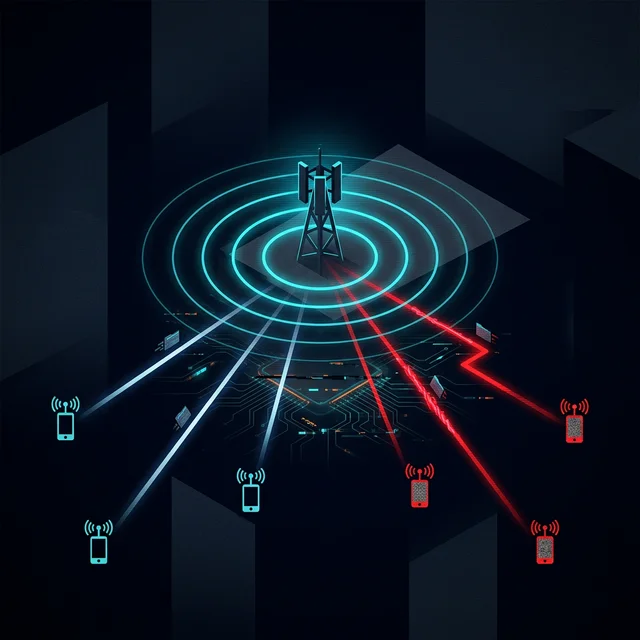
IMSI catchers are devices that impersonate legitimate cell towers to force nearby mobile devices to connect to them. Once connected, the attacker can harvest subscriber identities (IMSI/IMEI), track physical location with meter-level accuracy, intercept voice calls and SMS, and in advanced configurations inject malicious traffic directly into the victim's device or exploit baseband vulnerabilities in the modem firmware.
This research covers the operational principles of IMSI catchers, the specific protocol weaknesses they exploit across 2G through 5G, the evolution from passive to active interception platforms, real-world deployment case studies, and the emerging countermeasures available to both operators and end users.
- 2G has no mutual authentication — devices cannot verify the network.
- Downgrade attacks force 4G/5G devices onto vulnerable 2G.
- 5G SUCI encryption is the first real defense against IMSI catching.
- SDR-based implementations have democratized the attack capability.
- Detection remains an arms race between operators and adversaries.
I. How IMSI Catchers Work
An IMSI catcher exploits a fundamental asymmetry in legacy cellular protocols: while the network authenticates the subscriber (via the SIM), the subscriber has no way to authenticate the network. This means any radio transmitter broadcasting the correct System Information can impersonate a legitimate cell tower. The device's baseband processor — the dedicated chip that manages cellular connectivity — is designed to always select the strongest available signal, making it trivially easy for a rogue transmitter to attract connections.
A. Passive Mode (Identity Collection)
In passive mode, the IMSI catcher broadcasts as a legitimate cell tower with a stronger signal than surrounding towers, attracting nearby devices. When a phone connects, it transmits its IMSI and IMEI in cleartext during the initial attach procedure. The catcher logs these identifiers and then releases the device back to the legitimate network. This entire process is invisible to the user and typically completes in under 2 seconds.
Technical Detail: The passive catcher configures itself with the same Mobile Country Code (MCC), Mobile Network Code (MNC), and a Cell Identity that matches the target operator. It broadcasts a System Information Block (SIB) with artificially high power and a low Cell Reselection Priority, ensuring devices prefer it over legitimate towers. On GSM, the IMSI is captured during the Location Update Request; on LTE, during the Attach Request.
B. Active Mode (Man-in-the-Middle)
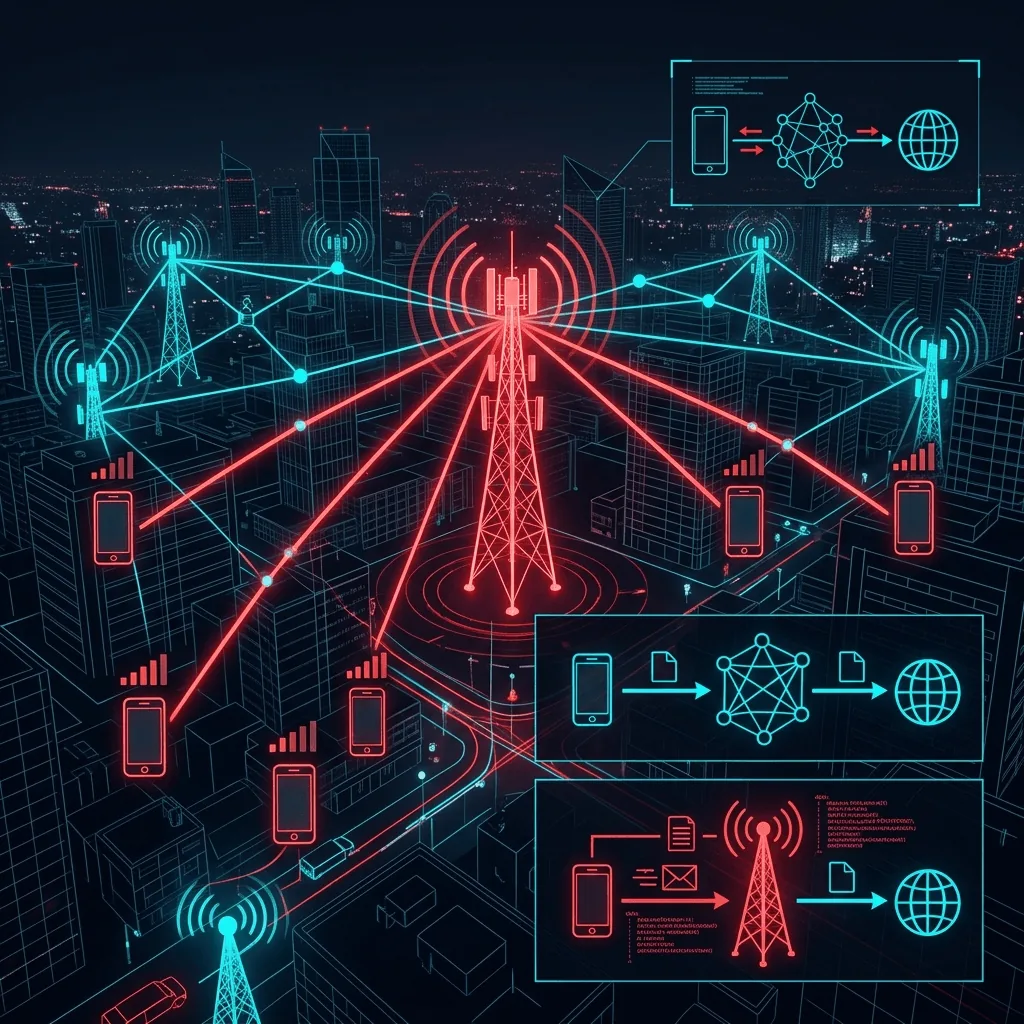
In active (MitM) mode, the IMSI catcher maintains a persistent connection with the victim device while simultaneously relaying traffic to the real network. This dual-connection allows the attacker to:
- Intercept and record voice calls in real time
- Read and modify SMS messages in transit (enabling SIM swap attacks)
- Inject silent SMS or type-0 SMS for precise location tracking
- Force the device to disable encryption (A5/1 → A5/0 downgrade)
- Exploit baseband vulnerabilities through crafted RRC/NAS messages
- Deploy over-the-air malware injection via manipulated data sessions
Encryption Downgrade Attack
Active IMSI catchers force encryption downgrades by manipulating the "ciphering mode command" sent to the device. On 2G, this means switching from A5/1 (weak but present) to A5/0 (no encryption). The device complies silently with no user notification. This same technique can force a device from 4G/5G down to 2G by sending an RRC Redirect or TAU Reject with appropriate cause values, effectively bypassing all modern encryption protections.
SDR WEAPONIZATION AND GTP INTERCEPTION
The transition from specialized hardware to Software Defined Radio (SDR) has fundamentally changed the economics of IMSI catching. Using srsRAN or Open5GS, an attacker can not only harvest identities but also establish a full-fledged fake eNodeB. By intercepting the initial Attach Request, the attacker can force the UE to use null-encryption (NEA0) for the user plane, allowing full cleartext interception of GTP (GPRS Tunneling Protocol) traffic before it ever hits the legitimate core network.
ANDROID 14 2G SECURITY HARDENING
The most effective end-user defense against legacy IMSI catchers is the total disabling of 2G connectivity. Android 14+ introduces a "Allow 2G" toggle in the SIM settings. Disabling this prevents the baseband from falling back to the unauthenticated GSM layer, effectively neutralizing 90% of commercial IMSI catchers that rely on 2G for call and SMS interception. For enterprise fleets, this setting can be enforced via MDM (Mobile Device Management) policies.
C. Advanced Capabilities
Modern IMSI catchers have evolved significantly beyond simple identity collection. State-of-the-art systems support:
| Capability | Technical Mechanism | Generation Affected |
|---|---|---|
| Identity Harvesting | Capture IMSI/IMEI during initial attach | 2G, 3G, 4G (pre-attach) |
| Location Tracking | Cell-ID triangulation + signal timing | All generations |
| Voice Interception | MitM relay with A5/0 downgrade | 2G, 3G (via downgrade) |
| SMS Interception | MitM relay, SMS forwarding | 2G, 3G, 4G (via downgrade) |
| Data Interception | GTP tunnel manipulation | 4G (via fake eNodeB) |
| Denial of Service | RRC Reject / TAU Reject flooding | 4G, 5G NSA |
| Baseband Exploitation | Crafted RRC/NAS messages | All (device-dependent) |
| Downgrade Forcing | RRC Redirect to lower RAT | 3G→2G, 4G→2G, 5G→4G→2G |
II. IMSI Catching Across Generations
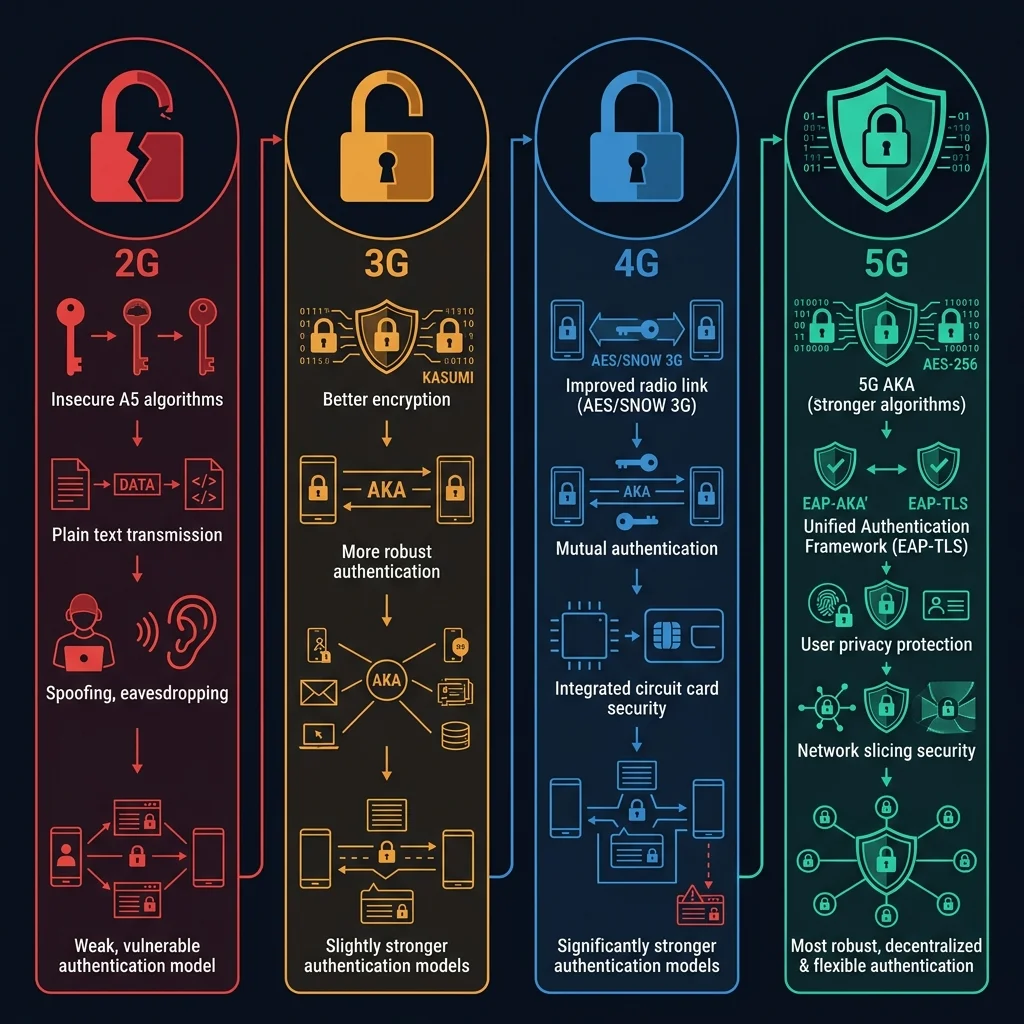
The effectiveness of IMSI catchers varies dramatically across cellular generations. Each new generation has attempted to address the authentication asymmetry, with 5G Standalone being the first to offer a genuine architectural solution. Understanding this evolution is essential for assessing the realistic threat to any given deployment — and it directly mirrors the evolution of mobile network standards through 3GPP releases.
2G GSM
Fully vulnerable. No mutual authentication, weak encryption (A5/1 — broken since 2003), IMSI sent in cleartext during Location Update. The original and easiest target for IMSI catchers. GSM remains active in many developing markets and as a fallback in legacy networks worldwide.
3G UMTS
Introduced mutual authentication via AKA (Authentication and Key Agreement). However, IMSI is still sent in cleartext before authentication completes, and downgrade to 2G remains trivial. KASUMI (A5/3) cipher has known theoretical weaknesses but is more resistant than A5/1.
4G LTE
Strong mutual authentication and mandatory encryption (SNOW 3G, AES). However, the IMSI is still transmitted in cleartext during the initial attach, and sophisticated catchers exploit RRC redirect commands and TAU Reject messages to force downgrades. Researchers at Purdue University demonstrated the "LTEInspector" attack in 2018, proving 4G IMSI catching remains feasible.
5G NR SA
First generation to encrypt the subscriber identity over the air via SUCI (Subscription Concealed Identifier, using ECIES). Passive IMSI catching is theoretically prevented, but active downgrade attacks to 4G/2G remain a threat until legacy shutdown, and SUCI correlation attacks are an emerging research area. See the 5G network security architecture.
Generational Security Comparison
| Security Feature | 2G GSM | 3G UMTS | 4G LTE | 5G NR SA |
|---|---|---|---|---|
| Mutual Authentication | ✗ No | ✓ AKA | ✓ EPS-AKA | ✓ 5G-AKA |
| Identity Protection | ✗ IMSI cleartext | ✗ IMSI cleartext | ✗ IMSI cleartext (attach) | ✓ SUCI encrypted |
| Encryption Strength | A5/1 (broken) | KASUMI (weak) | SNOW 3G / AES (strong) | NEA1/NEA2/NEA3 (strong) |
| Integrity Protection | ✗ None | ✓ Optional | ✓ Mandatory (control) | ✓ Mandatory (control + user) |
| Downgrade Resistance | N/A | ✗ Falls to 2G | ✗ Falls to 2G/3G | ✗ Falls to 4G/2G (until legacy off) |
| Passive IMSI Catching | Trivial | Easy | Feasible | Mitigated (SUCI) |
| Active MitM | Trivial | Moderate difficulty | Complex but proven | Very difficult (SA only) |
III. Detection and Countermeasures
Detecting IMSI catchers is challenging because they deliberately mimic legitimate infrastructure. The detection challenge is fundamentally asymmetric — the attacker controls the radio environment and can adapt parameters to evade any single detection method. An effective defense requires layering multiple approaches:
A. Endpoint Detection Methods
- RF Spectrum Analysis: Monitoring for anomalous signal strength patterns, duplicate cell IDs, or cells broadcasting with unusual parameters (very small tracking areas, specific EARFCN values, unusual System Information Block content). Professional-grade spectrum analyzers can identify rogue transmitters by their RF fingerprint characteristics.
- Baseband Diagnostics: Using rooted devices with tools like SnoopSnitch, AIMSICD, or MobileInsight to monitor RRC messages for suspicious redirect commands, cipher mode changes, or authentication anomalies.
- 2G Disable: Android 14+ includes a user setting to disable 2G connectivity entirely, which prevents the most common downgrade attack vector. This is a critical defensive measure in modern RAN environments.
B. Network-Side Detection
Operators have significantly more visibility into rogue base station activity:
- Authentication Failure Correlation: Spikes in authentication failures in a geographic area often indicate an IMSI catcher forcing attach attempts.
- Measurement Report Analysis: Analyzing UE measurement reports for references to unknown cells or cells with inconsistent parameters.
- Inter-RAT Handover Monitoring: Unexpected handovers from 4G/5G to 2G in areas with strong LTE coverage strongly indicate a downgrade attack.
- Timing Advance Analysis: Legitimate cells have consistent timing advance patterns; rogue cells often exhibit anomalous TA values due to different physical locations.
C. Physical Security Measures
For high-security environments (government facilities, corporate headquarters, embassies), physical countermeasures complement electronic detection:
| Countermeasure | Detection Method | Cost Level | Effectiveness |
|---|---|---|---|
| Fixed RF Sensors | Continuous spectrum monitoring, cell ID database comparison | High | Excellent for fixed perimeters |
| Mobile Detection Units | Vehicle-mounted wideband scanners | Very High | Excellent for sweeps |
| SnoopSnitch / AIMSICD | Baseband-level monitoring on rooted devices | Low | Moderate (limited to specific bands) |
| Managed SCIF Solutions | RF-shielded rooms blocking all cellular signals | Very High | Complete (but impractical for mobile use) |
| Network-Based Analytics | Operator-side anomaly detection on auth/handover patterns | Medium (operator cost) | Good (depends on operator cooperation) |
IV. Real-World Case Studies
A. Washington D.C. Unauthorized Stingrays (2017–2018)
The U.S. DHS confirmed the detection of unauthorized cell-site simulators operating in the vicinity of sensitive government facilities in Washington D.C., including near the White House and Capitol Hill. The origin of these devices was never publicly attributed, though both espionage and law enforcement operations were suspected. This incident triggered congressional hearings and highlighted the lack of regulatory framework for detecting and neutralizing unauthorized IMSI catchers on U.S. soil.
B. Law Enforcement Overreach Litigation
In the 2016 case United States v. Lambis, a federal judge ruled that the use of a Stingray device without a warrant violated the Fourth Amendment. The ruling established that IMSI catchers constitute a "search" under constitutional law because they collect data from all nearby devices indiscriminately — not just the target. This precedent has been reinforced by subsequent rulings, though legal standards remain inconsistent across jurisdictions.
C. Protest Surveillance Concerns
Reports from multiple countries document IMSI catcher deployment at political protests. The indiscriminate nature of these devices means that all attendees' identities are harvested — creating de facto surveillance of constitutionally protected assembly. Civil liberties organizations including the EFF and ACLU have documented these practices extensively.
The Democratization of IMSI Catching
The availability of low-cost Software Defined Radio (SDR) platforms like the USRP B210, HackRF, and BladeRF, combined with open-source cellular stacks (OpenBTS, srsRAN, Open5GS), has dramatically lowered the barrier to entry for IMSI catcher construction. What once required $500,000+ in commercial equipment can now be replicated for basic 2G/4G interception using under $5,000 in hardware and freely available software. This has shifted the threat model from state-only to include organized crime and individual actors. TelcoSec's private LTE/5G lab covers SDR-based cellular security research in controlled environments.
V. Building Lab Environments for IMSI Catcher Research
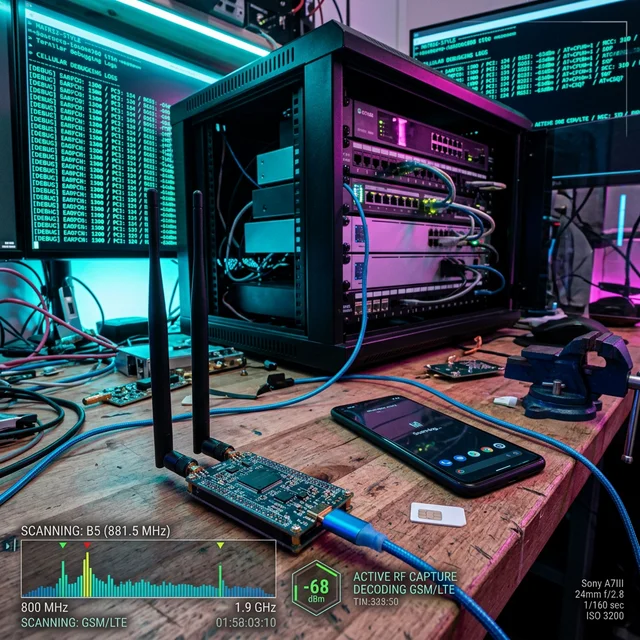
Security researchers and telecom professionals can replicate IMSI catcher scenarios in controlled laboratory settings using Software Defined Radio (SDR) platforms. This is essential for developing and validating detection countermeasures. Our comprehensive guide to setting up a private LTE/5G lab covers the full hardware and software stack required.
A basic research setup includes:
- SDR Hardware: USRP B210/B200mini, BladeRF x40, or LimeSDR USB
- Cellular Stack: srsRAN (4G/5G) or OpenBTS (2G) running on Linux
- SIM Management: Programmable test SIMs (sysmoISIM-SJA2) with custom Ki/OP keys
- Faraday Cage: Essential for legal compliance — all testing must be RF-shielded to prevent interference with production networks
- Analysis Tools: Wireshark with MAC-LTE/NAS dissectors, TelcoSec protocol analyzers
Understanding the RAN air interface vulnerabilities at the protocol level is essential context for designing effective detection algorithms. The telecom pentesting methodology article provides the operational framework for conducting these assessments professionally.
VI. Authoritative References
VII. Frequently Asked Questions
In many jurisdictions, law enforcement agencies use IMSI catchers under warrant authority. However, regulations vary widely by country, and their use has been challenged in courts due to the indiscriminate nature of the surveillance — they capture data from all nearby devices, not just the target. In the U.S., the Carpenter v. United States (2018) Supreme Court decision has raised the bar for location surveillance warrant requirements, though specific IMSI catcher legislation remains inconsistent. ::
Does disabling 2G on my phone fully protect me? ▼
Disabling 2G prevents the most common downgrade attack strategy, significantly reducing risk. However, advanced IMSI catchers targeting 4G LTE can still exploit initial cleartext IMSI transmission during the attach procedure, or use RRC redirect commands for other attack vectors. Full 5G SA with SUCI is the most robust protection currently available, though even it remains vulnerable to SUCI correlation attacks and baseband exploitation in smartphones.
How expensive is an IMSI catcher? ▼
Commercial-grade IMSI catchers from companies like L3Harris Technologies cost $50,000–$500,000+. However, open-source SDR-based implementations using tools like srsRAN and a USRP B210 can replicate basic 2G/4G IMSI catching capability for under $5,000 in a controlled lab environment. This democratization of the technology is a significant concern for the broader threat landscape.
Can an IMSI catcher read my encrypted messages (Signal, WhatsApp)? ▼
No — end-to-end encrypted messaging apps protect message content regardless of the transport layer. An IMSI catcher intercepting data traffic would only see encrypted ciphertext. However, it can still identify that you are communicating, track your physical location, harvest your IMSI/IMEI, and potentially exploit baseband vulnerabilities independently of the application layer. Metadata (who you communicate with and when) may still be exposed.
How can I tell if there's an IMSI catcher near me? ▼
With consumer-grade tools, reliable detection is extremely difficult. Apps like SnoopSnitch (requires rooted Android with Qualcomm baseband) can flag suspicious behavior, but they have significant false-positive rates and cannot detect sophisticated catchers that carefully mimic legitimate parameters. Professional RF spectrum analysis equipment provides more reliable detection but costs thousands of dollars. The most effective protection is disabling 2G on your device and using a 5G SA network when available.
What is the difference between an IMSI catcher and SS7 tracking? ▼
IMSI catchers operate at the physical radio layer — they require a radio transmitter in proximity to the target. SS7 tracking operates at the signaling network layer — it can be executed from anywhere in the world with SS7 interconnect access. IMSI catchers provide higher precision (meter-level vs. cell-tower-level for SS7) but require physical proximity. Both are complementary attack vectors that a sophisticated adversary will combine.
Conclusion & Next Steps
IMSI catchers exploit fundamental protocol weaknesses that persist across cellular generations. While 5G SA with SUCI encryption represents the first truly effective architectural countermeasure against passive IMSI catching, the coexistence of legacy networks — and the continued evolution of active interception techniques — ensures this attack vector will remain relevant well into the 2030s.
The defense landscape requires a multi-layered approach:
- Endpoint hardening — disable 2G connectivity, keep baseband firmware updated
- Network monitoring — deploy operator-side anomaly detection for auth failure patterns
- Physical security — RF environment assessments for sensitive facilities
- Protocol migration — accelerate transition to 5G Standalone with full SUCI deployment
- Ongoing testing — validate defenses using controlled lab environments and telecom pentesting methodology engagements
TelcoSec offers RF environment assessments and IMSI catcher detection audits for critical facilities, embassies, and corporate campuses. Explore our dedicated labs for controlled testing, review the RAN vulnerabilities for deeper technical context, or browse the TelcoSec research library for related threat intelligence.
DEFEND AGAINST ROGUE BTS?
Master Radio Access Network (RAN) defense. Learn to detect and mitigate IMSI catchers in our hands-on SDR labs. Enroll in the Academy to access the RBS research vault and srsRAN exploitation blueprints.