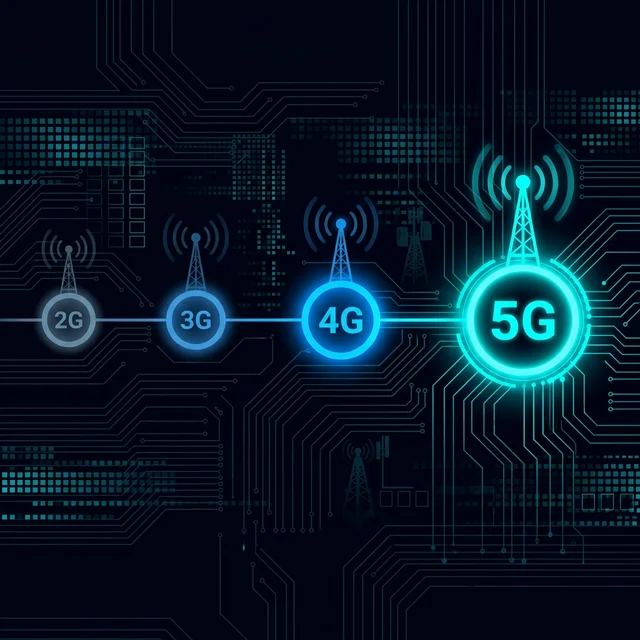
Every 3GPP release represents a shift in the telecom attack surface. Understanding the evolutionary path — from the first GSM specifications to 5G Advanced and the research roadmaps for 6G — is a prerequisite to understanding where modern telecom vulnerabilities originate and why legacy security weaknesses persist in today's converged networks.
The 3rd Generation Partnership Project (3GPP) is the consortium responsible for developing protocols and standards for mobile telecommunications. Rather than releasing massive, monolithic updates to network architecture, 3GPP operates on a system of parallel Releases, each introducing a freeze on a specific set of features that allows equipment manufacturers and telecom operators to develop interoperable hardware and software.
REFERENCE: 3GPP Security Evolution Roadmap
Download the complete technical roadmap of security control implementation from 3GPP Release 8 through Release 18, mapped to MITRE FiGHT techniques (PDF).
This guide traces the complete evolution of cellular network architecture and security across all 3GPP generations. Each generation introduced new capabilities — but also new attack surfaces. Understanding this evolution is essential for comprehending why modern 5G networks still carry vulnerabilities inherited from decades-old design decisions.
- 3GPP releases are cooperative — multiple generations can share overlapping releases
- Each generation's security model reflects the threat landscape of its era
- Legacy interworking creates persistent vulnerability chains across generations
- 5G Advanced (Rel 18/19) introduces AI/ML and satellite as new attack surfaces
I. Introduction to 3GPP and Release Cycles
The 3rd Generation Partnership Project (3GPP) is a consortium of seven regional telecommunications standards organizations that collaboratively develop protocols governing cellular networks worldwide. Every feature, protocol, and security mechanism in modern mobile networks can be traced to a specific 3GPP Release.
How 3GPP Releases Work
| Concept | Description |
|---|---|
| Release | A frozen set of specifications that define a complete, implementable feature set |
| Work Item | A specific technical project within a release (e.g., "SUCI concealment for 5G") |
| Technical Specification (TS) | The normative document defining a protocol (e.g., TS 33.501 for 5G security) |
| Study Item | Exploratory research preceding a Work Item — identifies feasibility and requirements |
| Freeze Date | The date after which a release's specifications cannot be modified (only corrected) |
Understanding this structure is critical for security researchers: vulnerabilities often exist because a security feature was defined in a later release but must interoperate with equipment built to an earlier freeze.
II. The 2G Era: GSM and the Birth of Mobile Security
The second generation fundamentally shifted communications from analog (AMPS/NMT) to digital, primarily focusing on voice and introducing SMS. GSM became the dominant global standard, using TDMA-based air interfaces.
2G Release Timeline
| Release | Key Features | Security Impact |
|---|---|---|
| Phase 1 & 2 (1992-1995) | Basic GSM voice, SMS, circuit-switched data | A3/A8 authentication (network-only) — no mutual auth. Rogue base stations trivial. |
| Phase 2+ / Rel 97 (1997) | GPRS — first packet data, GTP protocol introduced | GTP tunneling over untrusted IP — GTP exploitation begins. |
| Rel 98 (1998) | EDGE — 384 Kbps data | Minimal security changes. A5/1 encryption still standard. |
2G Security Analysis
The foundational security flaw of 2G: one-way authentication. The network authenticates the subscriber (via A3/A8 challenge-response using the SIM card's Ki), but the subscriber never authenticates the network. This enables trivial IMSI catchers deployment — a rogue base station can impersonate any legitimate cell tower.
Encryption Weaknesses
- A5/1: The primary GSM stream cipher, broken via rainbow tables as early as 2008. Real-time decryption is now possible with commodity hardware.
- A5/2: An intentionally weakened export cipher, broken in real-time since 2003.
- A5/0: Null encryption — no protection at all. Used in some countries by mandate.
Legacy Persistence
Despite being fundamentally broken, 2G GSM networks remain operational worldwide. Many 5G devices still support 2G fallback, enabling bidding-down attacks that force modern smartphones onto 30-year-old encryption.
III. The 3G Era: UMTS and Mutual Authentication
When 3G emerged, the focus actively shifted from pure voice toward mobile broadband. UMTS replaced GSM's TDMA with W-CDMA (Wideband Code Division Multiple Access), and critically, introduced the first meaningful defense against rogue base stations.
3G Release Timeline
| Release | Key Features | Security Impact |
|---|---|---|
| Rel 99 (2000) | Baseline UMTS, W-CDMA air interface | UMTS-AKA mutual authentication — first defense against IMSI catchers. KASUMI replaces A5/1. |
| Rel 4 (2001) | All-IP core network option | MSC Server/MGW split — beginning of IP-based signaling |
| Rel 5 (2002) | HSDPA (14.4 Mbps), IMS introduction | IP Multimedia Subsystem — SIP-based voice over IP. New VoIP attack surface. |
| Rel 6 (2005) | HSUPA (5.76 Mbps uplink) | WLAN interworking — first Wi-Fi/cellular convergence |
| Rel 7 (2007) | HSPA+ with MIMO (42 Mbps) | Enhanced security for MBMS (broadcast services) |
3G Security Improvements and Remaining Gaps
UMTS-AKA (Authentication and Key Agreement) was the single most important security advancement in mobile history. For the first time, the subscriber could verify the network's identity — not just the other way around. This theoretically eliminated IMSI catchers.
However, critical gaps remained:
- IMSI still transmitted in cleartext during the initial attach procedure
- KASUMI cipher (used for UMTS encryption) has theoretical weaknesses (related-key attacks), though no practical exploitation has been demonstrated
- SS7 vulnerabilities remained the core network signaling protocol — all SS7 vulnerabilities (location tracking, SMS interception, call redirection) persisted unchanged
- Downgrade attacks: 3G UEs still supported 2G fallback, allowing attackers to force devices onto broken GSM encryption
IV. The 4G Era: The All-IP Network
4G LTE marked the death of the legacy circuit-switched core. The Evolved Packet Core (EPC) ran entirely over IP, replacing SS7 with Diameter for signaling — but inheriting the same fundamental trust model that made SS7 vulnerable.
4G Release Timeline
| Release | Key Features | Security Impact |
|---|---|---|
| Rel 8 & 9 (2008-2009) | LTE baseline, EPC architecture | Diameter protocol replaces SS7 — inherits trusted peer model. SNOW 3G + AES-128 encryption. |
| Rel 10 (2011) | LTE-Advanced, carrier aggregation | Enhanced key management for multi-carrier operation |
| Rel 11 (2012) | CoMP (Coordinated Multi-Point) | Inter-eNB coordination over X2 — new lateral movement surface |
| Rel 12 (2015) | Small cells, D2D (ProSe) | Massively increased physical access points for IMSI catchers attacks. D2D introduces peer communication security. |
| Rel 13 & 14 (2016-2017) | LTE-Advanced Pro, NB-IoT/LTE-M | IoT integration — constrained devices with minimal security. Dual connectivity with 5G NR. |
4G Security: New Protocol, Inherited Trust
The transition from SS7 to Diameter was a security opportunity missed. While Diameter added TLS/IPSec support, the roaming interconnect model still assumed trusted peers — Diameter Edge Agents were often deployed without proper filtering, enabling the same categories of attacks that plagued SS7:
- Subscriber location tracking via CLR/ULR message manipulation
- Authentication vector theft from the HSS via AIR (Authentication-Information-Request)
- Subscriber denial of service via Cancel-Location-Request
- Billing fraud via Insert-Subscriber-Data with modified QoS profiles
Rel 13 & 14 / 4G Advanced Pro
Laid the groundwork for 5G. Integrated unlicensed spectrum (LTE-U/LAA), massive IoT (NB-IoT/LTE-M for billions of constrained devices), and dual connectivity with 5G NR. The IoT expansion created a vast new attack surface of devices with minimal cryptographic capability and long deployment lifecycles (10+ years without firmware updates).
V. The 5G Era: Cloud-Native Security
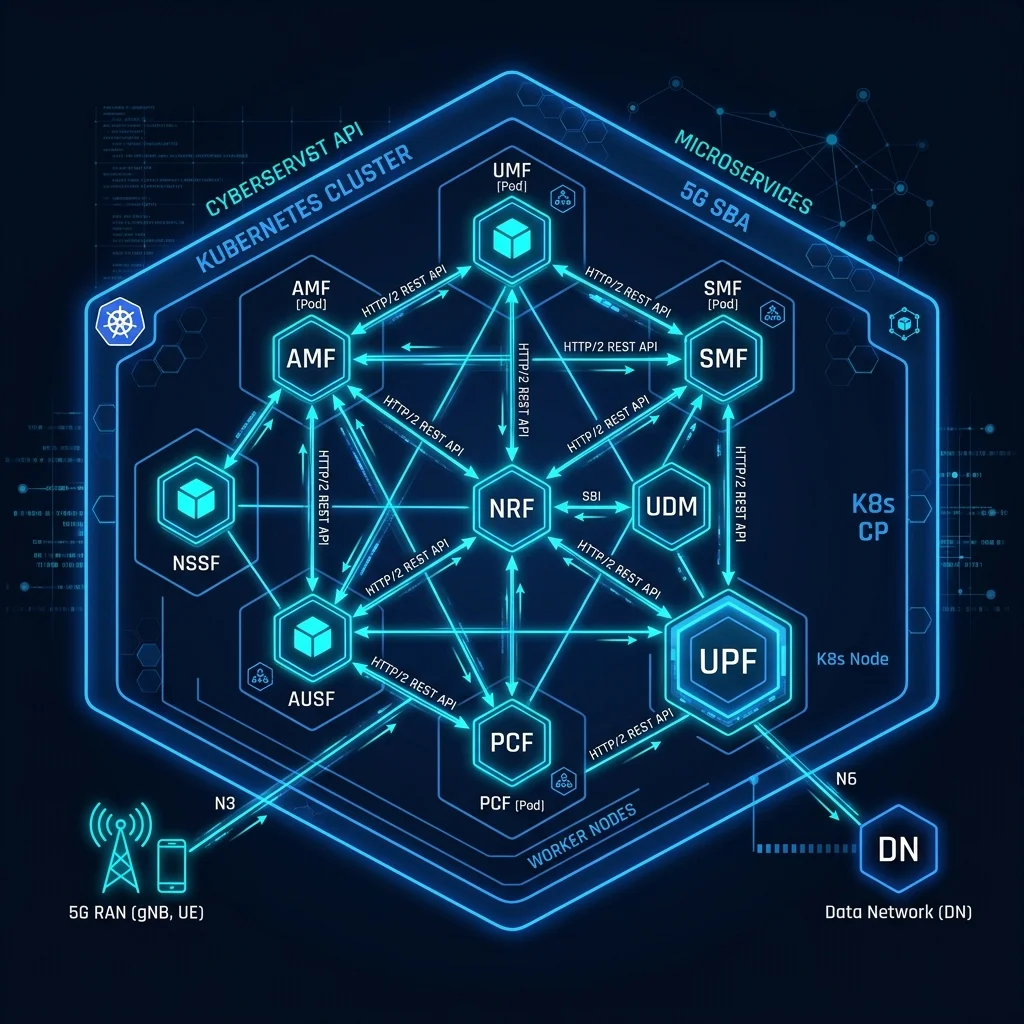
5G is defined by the transformation from hardware appliances to cloud-native, Service-Based Architectures (SBA). The 5G Core (5GC) becomes, fundamentally, a Kubernetes cluster running HTTP/2 microservices.
5G Release Timeline
| Release | Key Features | Security Impact |
|---|---|---|
| Rel 15 (2018) | 5G NR Phase 1 (NSA & SA), SBA core | SUCI concealment, 5G-AKA, OAuth 2.0 for NF authorization. See 5G network security architecture. |
| Rel 16 (2020) | IIoT, URLLC, V2X | Network slicing security, time-sensitive networking. Enhanced SUPI protection. |
| Rel 17 (2022) | NR-Light (RedCap), NTN (satellite) | Reduced capability devices — constrained security profiles. Satellite backhaul security. |
5G Security Advancement Matrix
| Security Feature | 2G | 3G | 4G | 5G |
|---|---|---|---|---|
| Mutual Authentication | ❌ | ✅ UMTS-AKA | ✅ EPS-AKA | ✅ 5G-AKA |
| Identity Concealment | ❌ IMSI cleartext | ❌ IMSI cleartext | ❌ IMSI cleartext | ✅ SUCI (ECIES) |
| Home Network Auth | ❌ | ❌ | ❌ | ✅ AUSF verification |
| User Plane Encryption | A5/1 (broken) | KASUMI | SNOW 3G/AES | SNOW/AES/ZUC |
| Signaling Protocol | SS7 vulnerabilities (no encryption) | SS7 vulnerabilities (no encryption) | Diameter protocol (optional TLS) | HTTP/2 (mTLS) |
| Core Architecture | Monolithic switches | Monolithic + IP | Flat IP (EPC) | 5G SBA vulnerabilities |
| Interworking Risk | N/A | 2G fallback | 2G/3G fallback | 2G/3G/4G fallback |
Rel 18 & 19 / 5G Advanced
Currently bridging toward 6G. Introduces native AI/ML in the RAN (via the O-RAN RIC) and Core, satellite (NTN) integration, and Ambient IoT. AI/ML models introduce adversarial machine learning as an entirely new telecom attack vector — crafted radio inputs can cause misclassification in AI-driven scheduling and resource optimization.
VI. 5G Advanced Deep-Dive (Rel 18/19)
AI/ML-Native RAN
Rel 18 embeds ML in the RIC (RAN Intelligent Controller). This creates a surface for adversarial ML attacks — crafted radio inputs causing misclassification patterns in beam management, handover prediction, and resource scheduling. Model poisoning via compromised training data is a critical supply-chain risk.
Non-Terrestrial Networks (NTN)
Satellite integration extends coverage to maritime, aviation, and rural areas but introduces propagation delays (250ms+ for GEO) and expands the physical interception surface beyond terrestrial fiber. The satellite-to-ground link becomes a new air interface attack vector.
Extended Reality (XR) & Metaverse
Rel 18 introduces XR-aware scheduling with strict QoS requirements (5ms latency, 100 Mbps). These demanding SLA guarantees create amplification vectors for starvation attacks on adjacent slices — degrading XR service to extort operators.
Ambient IoT
Rel 19 targets ultra-low-power devices harvesting RF energy (no battery). Minimal compute capability means minimal cryptographic protection — creating a class of inherently vulnerable endpoints that will persist in the network for 15-20 years without firmware updates.
VII. The Path to 6G: 2030 and Beyond
6G is envisioned as an Integrated Sensing and Communication (ISAC) ecosystem where the network acts as a high-resolution radar — simultaneously communicating data and sensing the physical environment.
6G VULN VECTORS
The Future Attack Surface
- Terahertz (THz) Interception: Higher frequencies (100 GHz – 10 THz) create new scattering surfaces for eavesdropping, but also require line-of-sight, limiting passive interception range.
- Privacy Erosion through ISAC: gNodeB "seeing" people through RF sensing (gesture recognition, occupancy detection, object tracking) creates unprecedented surveillance capability that requires standardized "Sensing Privacy" controls.
- Post-Quantum Cryptography (PQC): 6G will likely deprecate RSA/ECC for quantum-resistant algorithms (CRYSTALS-Kyber, CRYSTALS-Dilithium). The transition period creates interoperability vulnerabilities.
- AI-Native Architecture: 6G assumes pervasive AI/ML for network optimization. This makes adversarial ML a first-class threat category, not an afterthought.
- Digital Twin Exploitation: 6G envisions real-time digital twins of the physical network. Compromising the twin enables attack simulation and planning with perfect fidelity.
VIII. Security Paradigm Shifts Between Generations
2G A5/1 Stream Cipher — Fundamentally Broken
A5/1 was broken via rainbow tables as early as 2008. 2G provides no mutual authentication, enabling trivial fake base station attacks. SIM cloning via COMP128v1 was feasible until algorithm replacement.
3G KASUMI — Improved But Flawed
3G introduced mutual authentication (UMTS-AKA) and KASUMI cipher, significantly raising the bar. But it still relied on SS7 for core signaling, maintaining all interconnect-level intercept vulnerabilities unchanged.
4G Diameter Exposure — New Protocol, Inherited Trust
4G replaced SS7 with Diameter protocol but inherited the fundamental trusted-peer interconnect model. Signaling firewalls (DEA/DRA) became necessary but were inconsistently deployed, leaving the majority of operators vulnerable to roaming-based attacks.
5G SBA + OWASP — IT Meets Telco
5G's 5G SBA vulnerabilities secures inter-NF communication with mTLS and OAuth2, but the cloud-native architecture inherits the entire OWASP Top 10 (BOLA, SSRF, mass assignment). Network slicing adds isolation complexity.
IX. Generation Comparison Matrix
The following diagram presents a side-by-side comparison of the architectural differences across generations:
X. Authoritative References
XI. Frequently Asked Questions
What is the difference between a 3GPP Release and a generation? ▼
A generation (like 4G or 5G) is a marketing and architectural milestone, while a 3GPP Release is a technical package of specifications. For example, 5G spans multiple releases (15, 16, 17, 18), each adding new features and security controls to the base generation. A single release can also span multiple generations — Release 8 formalized 4G LTE but also defined enhancements for 3G HSPA+.
Why is legacy interworking a security risk? ▼
Modern 5G networks often have to fall back to 4G or even 3G/2G when coverage is weak or during roaming. This enables bidding-down attacks that force a 5G phone to use a legacy, broken protocol where vulnerabilities like unencrypted IMSI transmission, weak ciphers (A5/1), and unfiltered SS7 vulnerabilities still exist. Interworking Functions (IWF) translate between generations but often fail to enforce the security posture of the newer generation.
When will 2G/3G networks be shut down? ▼
Timelines vary by region. The US has largely decommissioned 2G/3G (AT&T shut down 3G in 2022, T-Mobile shut down 2G in 2024). Europe targets 2025-2028 for 2G/3G sunset. Many countries in Asia, Africa, and South America plan to maintain 2G infrastructure through 2030+ for IoT and rural coverage. Until full sunset, the legacy attack surface persists.
How does each generation handle subscriber identity? ▼
2G/3G: IMSI transmitted in cleartext during initial attach. 4G: Still IMSI in cleartext (GUTI used after initial attach, but IMSI required for initial registration). 5G: SUCI (Subscription Concealed Identifier) encrypts the IMSI using the home network's public key (ECIES), preventing IMSI catchers identity capture. However, SUCI implementation quality varies by operator and SIM card.
What security features does 5G Advanced (Rel 18) add? ▼
Rel 18 focuses on: AI/ML security (protecting RAN intelligent controllers from model poisoning), enhanced slice authentication (per-slice re-authentication), improved satellite security for NTN, and strengthened AKMA (Authentication and Key Management for Applications) for IoT authentication. It also begins groundwork for post-quantum cryptography migration.
Why should security researchers study 3GPP releases? ▼
Every vulnerability in modern telecom can be traced to a specific 3GPP specification. Understanding which release introduced a feature (and which release attempted to fix its security gaps) is essential for effective telecom pentesting methodology. For example, knowing that Diameter's trusted-peer model was inherited from SS7 (pre-Release 8) explains why Diameter signaling firewalls are necessary today.
Conclusion & Next Steps
The evolution of mobile networks is the evolution of the attack surface. Each generation solved some security problems while introducing new ones: 2G's broken encryption led to 3G's mutual authentication; 3G's reliance on SS7 vulnerabilities led to 4G's adoption of Diameter protocol; 4G's inherited trust model led to 5G's OAuth and mTLS; and 5G's cloud-native SBA introduced the entire OWASP vulnerability landscape into telecom.
For security researchers, this historical context is not academic — it directly informs telecom pentesting methodology:
- Legacy interworking remains the weakest link in any modern network
- Signaling protocol evolution (SS7 vulnerabilities → Diameter protocol → HTTP/2) shows a clear pattern of inherited trust assumptions
- Identity protection (IMSI → SUCI) shows progressive improvement but requires proper SIM provisioning
- The 5G/6G boundary will introduce AI/ML and quantum computing as first-class threat categories
MASTER 3GPP SECURITY STANDARDS?
Understanding the evolution of 3GPP releases is critical for modern telecom security. Enroll in our Academy to master the technical specifications from Rel-8 to Rel-18 and beyond.