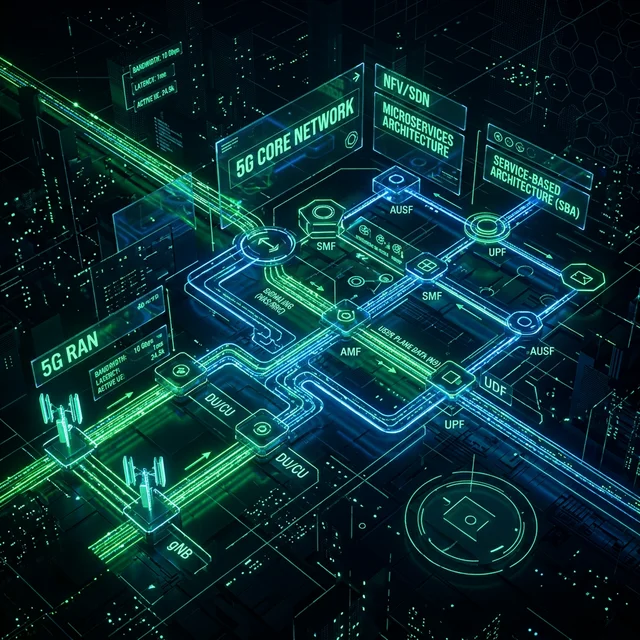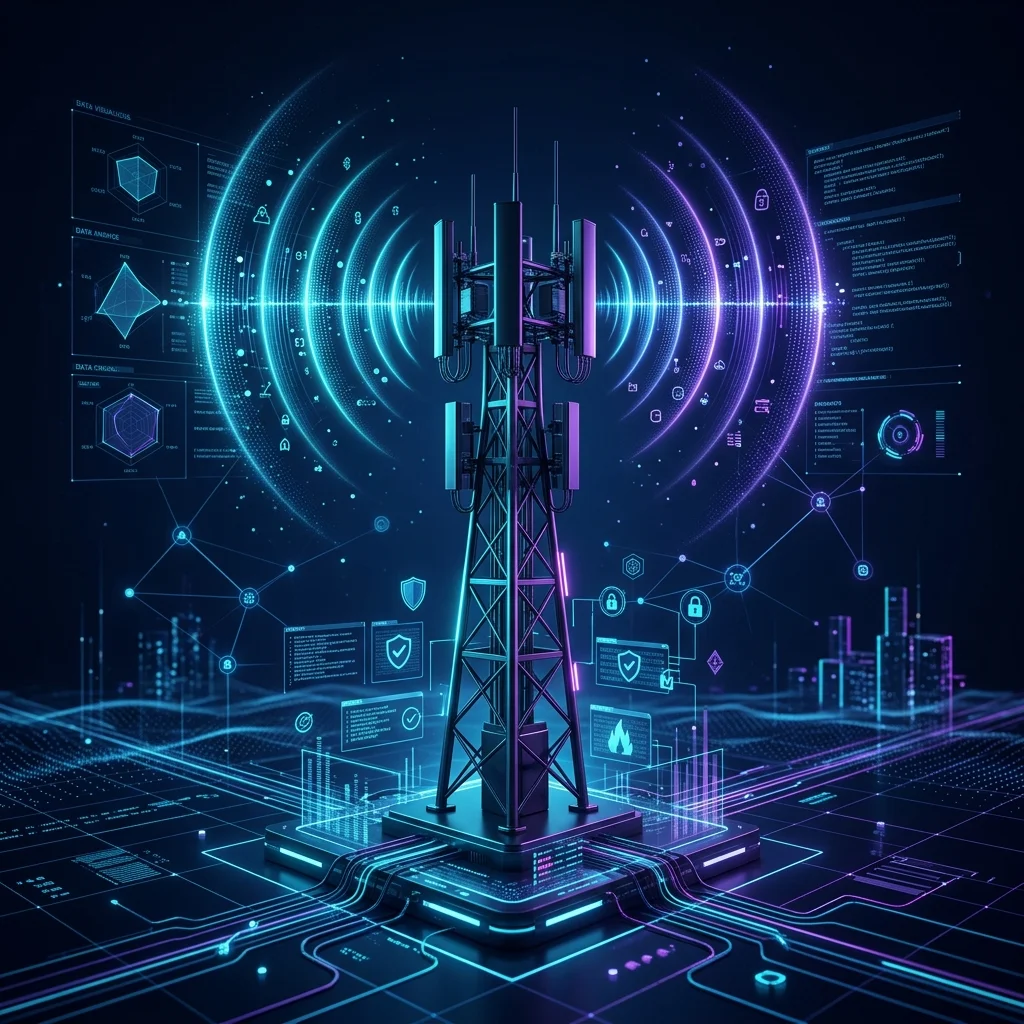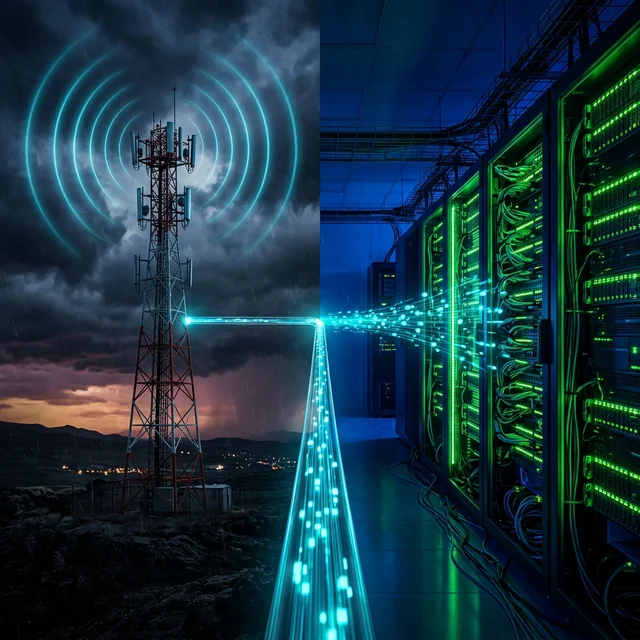
Telecommunications focused on moving data. Computer Networks focused on controlling it. The Internet is where they collide — and where security research must begin. Understanding the fundamental distinction between these two disciplines is not an academic exercise: it is the prerequisite for comprehending why modern telecom vulnerabilities exist and how cross-domain exploitation works.
The most critical vulnerabilities in modern infrastructure do not exist within pure telecommunications or pure IT elements. They exist in the seam between them — the protocols tasked with translating physical radio signals into routable IP networks.
"Critical infrastructure weaknesses are found not within telecom or IT in isolation, but at their intersection — where radio signals must cross into routable IP networks."
BLUEPRINT: Converged Network Threat Model
Download the architectural blueprint for mapping cross-domain vulnerabilities between RAN, Core, and IT infrastructure (PDF).
[ CONVERGENCE ANALYSIS MATRIX ]
This intelligence briefing deconstructs the architectural, protocol, and security paradigms separating legacy telecommunications from modern computer networks.
It traces the critical convergence timeline—from the introduction of GPRS (2G) to the fully cloud-native 5G Service Based Architecture (SBA)—and maps the resulting cross-domain attack surface.
For security researchers, understanding this intersection is vital. It is where physical radio frequencies translate into routable IP traffic, exposing critical 5G SBA vulnerabilities and core network blind spots.
- â–¶Divergent Trust ModelsTelco and IT networks historically operated under fundamentally opposed security paradigms.
- ▶Cross-Domain Pivot4G/5G convergence introduces lethal exploitation paths spanning RF → IP → Cloud.
- â–¶Hardware EscapesBaseband-to-AP pivots bridge the gap between physical RF manipulation and OS-level IP networking.
- â–¶Inspection FailureProtocol encapsulation, such as GTP tunnel blindness, allows attackers to bypass standard enterprise firewalls.
- â–¶The Final FrontierCloud-native architecture collapses the traditional telecom boundary, transforming core network exploitation into standard IT lateral movement.
I. The Physical Plane: Telecommunications Networks
Telecommunications, at its core, is the discipline of moving raw signals across physical distances. Whether it is a copper pair, a coaxial cable, a fiber optic strand using DWDM/CWDM, or the electromagnetic spectrum via licensed radio frequencies, the fundamental goal is singular: maintain signal integrity over distance and interference.
The tooling and vocabulary here are measured in physical quantities: signal-to-noise ratio (SNR), resource blocks, QAM modulations, and dBm. Standards drafted by 3GPP and ITU-T rigidly govern how these analog signals are modulated, scheduled, and handed over between eNodeBs/gNodeBs in the Radio Access Network (RAN).
Telecom Network Characteristics
| Characteristic | Description | Security Implication |
|---|---|---|
| Stateful Connections | Explicit radio states (RRC_IDLE vs RRC_CONNECTED) tracked per subscriber | State machine vulnerabilities, bidding-down attacks |
| Licensed Spectrum | Exclusive frequency allocations governed by national regulators | Physical-layer attacks require SDR equipment and RF expertise |
| Synchronous Timing | Strict timing requirements (microsecond-level synchronization) | Timing attacks can disrupt cell operations |
| Circuit-Switched Legacy | Historical voice networks with dedicated bandwidth per call | SS7 vulnerabilities still operational for interconnect |
| National Infrastructure | Networks span entire countries/continents | Single vulnerability can affect millions of subscribers |
| Vendor-Locked Hardware | Proprietary baseband units, SIM cards, radio equipment | Limited visibility for security auditing |
Key Transport Protocols
- CPRI/eCPRI (Fronthaul): Prior to 5G, fronthaul connections between the Remote Radio Head (RRH) and Baseband Unit (BBU) used CPRI — a strict, synchronous protocol carrying raw IQ radio samples. 5G introduced eCPRI, encapsulating these physical radio samples directly into Ethernet frames, blurring the physical/digital line at the cell tower itself.
- GTP (GPRS Tunneling Protocol): The protocol that bridges the radio and IP worlds. GTP-U carries user plane data in UDP tunnels between the RAN and core. GTP-C handles control signaling between core network functions. Both operate on standard IP but carry telecom-specific semantics that enterprise firewalls cannot inspect.
- SS7/SIGTRAN: Legacy circuit-switched signaling adapted for IP transport. SIGTRAN carries SS7 MAP/ISUP messages over SCTP/IP, maintaining the original trusted-peer security model of the PSTN era on modern IP infrastructure.
- Diameter protocol: 4G's replacement for SS7, running on SCTP/TCP with optional TLS. Despite being IP-native, Diameter inherited the fundamental assumption of trusted interconnect peers.
ANALYST NOTE: A Telco network without IP integration is not "less secure" — it is a different threat model. SS7 vulnerabilities protocols' original design assumed a closed, trusted network of carrier-class switches. The convergence with IP created a new exposure surface that was never anticipated by the protocol designers of the 1970s-1980s.
II. The Logic Plane: Computer Networks
Where telecommunications transports, computer networking manages. Once a signal arrives at a destination node, a separate, parallel universe of protocols takes over: the world of IP, Ethernet, DNS, and TCP/UDP. Computer networks are inherently designed around distrust — the assumption that any node may be compromised, any link may be intercepted, and any packet may be forged.
Computer Network Characteristics
| Characteristic | Description | Security Implication |
|---|---|---|
| Stateless Routing | Packets routed independently based on destination address | Spoofing, hijacking, DDoS amplification |
| Shared Medium | Best-effort delivery over shared infrastructure | Eavesdropping, man-in-the-middle |
| Open Standards | Publicly documented protocols (RFCs) | Well-understood attack vectors, robust tooling |
| Defense in Depth | Layered security (firewalls, IDS, WAF, encryption) | Mature security ecosystem |
| Rapid Patching | Software-defined, easily updated | Fast remediation cycles |
| Zero Trust Models | Assume breach, verify continuously | Modern security architectures (BeyondCorp, ZTNA) |
Key Logic Plane Components
IP Addressing & Routing
Layer 3 protocols assign logical identities to nodes and determine optimal forwarding paths. BGP, OSPF, and IS-IS are the languages of the global internet's routing table — and also key attack surfaces via route hijacking. A BGP hijack against an MNO's IP prefix can redirect all subscriber traffic through an adversary's infrastructure.
LAN & WAN Segmentation
Ethernet segmentation, VLAN trunking, and switching-fabric design define the horizontal attack surface within an operator's core. A compromised network function in a 5G SBA vulnerabilities has routing adjacency to the entire flat IP fabric, enabling lateral movement to high-value NFs like the AUSF and UDM.
Firewalls & Security Policies
Access control at the network layer. In an LTE EPC, the PDN Gateway enforces policy via Gx/Gy Diameter protocol interfaces — demonstrating that the boundary between telecom and computer networking protocols is entirely blurred. In 5G, Kubernetes NetworkPolicies replace traditional firewalls for inter-NF segmentation.
Service Discovery & Orchestration
DNS, NTP, and DHCPv6 provide the fundamental naming and coordination fabric. In a 5G SA deployment, the NRF (Network Repository Function) essentially performs IP-native service discovery — a DNS-equivalent for network functions. NRF poisoning is the telecom equivalent of DNS cache poisoning.
III. The Convergence: How They Combine
The emergence of All-IP architectures in the 2000s — and the formalization of this model in LTE (4G) — collapsed the distinct boundaries between the telecom and computer networking worlds. The Evolved Packet Core (EPC) ran entirely over IP, connecting RAN nodes via GTP (GPRS Tunneling Protocol) tunnels atop UDP/IP.
"Data Transport (Telco) + Data Management (Computer Networks) = THE INTERNET"
Convergence Timeline
| Era | Convergence Milestone | Security Consequence |
|---|---|---|
| Pre-2000 | Separate networks (PSTN + Internet) | Isolated threat models |
| 2000-2008 | GPRS/EDGE — first IP tunneling in GSM | GTP-over-IP introduces tunnel blindness |
| 2008-2018 | LTE EPC — all-IP core, Diameter replaces SS7 | Enterprise IT attacks become telecom-relevant |
| 2018-present | 5G SBA vulnerabilities — Kubernetes + HTTP/2 microservices | Full convergence — OWASP Top 10 applies to telecom |
| 2030+ | 6G — AI-native, ISAC, post-quantum | Adversarial ML + quantum attacks |
The "Link" between both planes is not a single technology — it is an architectural principle. In 5G Standalone (SA), this convergence reaches its logical conclusion: Network Functions are microservices communicating via HTTP/2 REST APIs on a flat IP fabric, yet they are intrinsically carrying subscriber signaling data across a licensed RF radio access network.
IV. Security Implications of the Convergence
For a security researcher, understanding the boundary between the transport and logic planes is fundamental. Modern exploitation happens when an attacker forces the infrastructure to translate a controlled payload from one domain into the other.
Attack Surface Convergence
As the technologies converge, so do the attack surfaces.
THREAT 01 Baseband to Application Pivot (RAN-to-OS)
The UE baseband chip processes raw radio signals using embedded RTOS software. If an attacker uses an SDR platform to send a malformed ASN.1 encoded RRC message, they can trigger a heap overflow in the baseband. Because modern SoC architectures share memory regions or IPC channels between the baseband and application processors, the attacker can pivot from the specialized telecom processor directly into the Android/Linux kernel running on the Application Processor — completing the jump from RF to IP.
Kill Chain: Rogue gNB → Malformed RRC message → baseband exploitation in smartphones → Shared memory write → AP kernel compromise → Full device control
THREAT 02 Tunnel Blindness (IP-to-Core)
GTP (GPRS Tunneling Protocol) encapsulates mobile data inside standard UDP packets (port 2123 for GTP-C, port 2152 for GTP-U). Most enterprise IT firewalls inspect Layer 3/4 headers but cannot parse GTP inner payloads. If an attacker breaches an adjacent IT server, they can craft customized GTP-C packets. The IT firewall sees standard UDP traffic and allows it through, unknowingly permitting direct exploits against the MME, SGW, or SMF in the telecom core.
Kill Chain: Compromised IT server → Craft GTP-C packets → IT firewall pass-through → Direct MME/SMF exploit → Core network compromise
# Demonstrating GTP tunnel blindness
  # A crafted GTP-C packet appears as normal UDP to IT firewalls

from scapy.all import *
from scapy.contrib.gtp import *

  # GTP-C Create Session Request
  # This targets the SMF/PGW on the telecom core
gtp_pkt = IP(dst='10.0.0.1') / \
          UDP(dport=2123) / \
          GTPHeader(version=2, T=1, teid=0x12345678) / \
          GTPCreateSessionRequest(
              imsi='001010123456789',
              apn='internet',
              rat_type=6  # NR (5G)
          )

  # Enterprise firewall sees: UDP port 2123 → ALLOWED
  # Telecom core sees: Forged session creation request
send(gtp_pkt)
THREAT 03 SBA Flat Fabric Exploitation (Cloud-Native Pivot)
5G Standalone (SA) replaces proprietary telecom interfaces with a Service Based Architecture (SBA) — effectively a Kubernetes cluster running microservices. Authentication shifts from physical link security to TLS and OAuth2. If an attacker breaches a minimally privileged web portal on the edge of the cluster, they gain access to the flat internal container network. Without rigorous zero-trust policies and proper Kubernetes NetworkPolicies, they can query the NRF and launch REST API attacks against the UDM (Unified Data Management), mimicking a legitimate core node.
Kill Chain: Edge web portal compromise → Container escape → Flat K8s network → NRF discovery → UDM API exploitation → Subscriber data exfiltration
V. Cross-Domain Security Framework
Securing the convergence requires a framework that spans both the telecom and IT security domains. Neither discipline alone provides sufficient coverage.
Security Control Mapping
| Security Control | Telecom Domain | IT Domain | Convergence Gap |
|---|---|---|---|
| Authentication | 5G-AKA (SIM-based) | OAuth2, OIDC, SAML | SIM swap bypasses 5G-AKA; OAuth misconfig bypasses SBA auth |
| Encryption | SNOW 3G, AES-128, ZUC (air interface) | TLS 1.3, IPSec (transport) | GTP tunnels may be unencrypted inside "trusted" backhaul |
| Access Control | Diameter Signaling firewalls (DEA/DRA) | WAF, NetworkPolicies, IAM | Signaling firewalls don't inspect HTTP/2; WAFs don't understand GTP |
| Identity | IMSI/SUPI/GUTI | X.509 certificates, JWTs | NF identity (cert) ≠ subscriber identity (SUPI) |
| Monitoring | SS7/Diameter probes, RAN KPIs | SIEM, EDR, NDR | Cross-domain correlation requires unified telemetry |
| Incident Response | NOC (Network Operations Center) | SOC (Security Operations Center) | Separate teams, tools, and escalation paths |
Recommended Cross-Domain Capabilities
- Unified Visibility: Deploy monitoring that correlates SS7 signaling with IT security telemetry (SIEM integration)
- GTP-Aware Firewalls: Replace or augment IT firewalls with GTP-aware inspection engines at the telecom/IT boundary
- SBA API Security: Apply 5G SBA security to all NF endpoints, not just IT-facing APIs
- Cross-Domain Red Teaming: Execute penetration tests that span from the air interface through the core to the IT backbone — not siloed assessments
- Converged SOC/NOC: Train security analysts on both telecom protocols and IT security, or establish cross-functional teams
VI. Authoritative References
VII. Frequently Asked Questions
Why is the convergence of telco and IT networks a security problem? ▼
Each domain was designed with different trust assumptions. Telecom networks assumed closed, trusted peering between a small number of licensed operators. IT networks assumed open, hostile environments with layered defenses. When these merge (as in 5G SBA), the telecom protocols may lack the defense-in-depth expected in IT, while IT security tools may not understand telecom-specific protocols like GTP or Diameter protocol. Attackers exploit this gap by translating attacks across domains.
What is GTP tunnel blindness? ▼
GTP (GPRS Tunneling Protocol) encapsulates mobile subscriber traffic inside standard UDP packets. Enterprise firewalls that inspect only the outer IP/UDP headers cannot see the GTP inner payload, which may contain malicious telecom signaling. This allows attackers on the IT side to send crafted GTP messages that pass through firewalls undetected, directly targeting core network functions.
How does 5G SBA change the security model? ▼
5G SBA vulnerabilities replaces proprietary telecom interfaces with standard HTTP/2 APIs running on Kubernetes. This means the 5G core is now subject to standard web application vulnerabilities (BOLA, SSRF, injection) alongside telecom-specific threats. Security teams must combine API security testing (OWASP) with signaling protocol analysis — a skill set that few organizations currently possess.
Can IT security tools protect telecom infrastructure? ▼
Standard IT tools (SIEM, EDR, WAF, vulnerability scanners) can protect the IT-facing components of a telecom network but are blind to signaling-layer threats. They cannot parse SS7 MAP, Diameter AVPs, or GTP-C messages. Conversely, telecom-specific tools (signaling firewalls, protocol analyzers) don't understand OWASP-class vulnerabilities. Effective protection requires both, ideally integrated into a unified monitoring platform.
What is a cross-domain attack chain? ▼
A cross-domain attack chain exploits vulnerabilities across both the telecom and IT domains in sequence. For example: compromise an IT-facing MEC portal → escape the container → access the flat Kubernetes network → discover NFs via the NRF → exploit BOLA in the UDM API → exfiltrate subscriber data. No single-domain security assessment would detect this chain; only a holistic pentest spanning both domains would identify it.
Where do I start learning about telecom security? ▼
Start with the fundamentals in this article, then progress through the TelcoSec research library in this order: (1) 3GPP Evolution for historical context, (2) 5G Architecture for modern core design, (3) SS7 vulnerabilities and Diameter protocol for signaling protocol security, (4) RAN Air Interface for radio-level threats, (5) Lab Setup for hands-on research, and (6) Pentest Methodology for the complete offensive lifecycle.
Conclusion & Next Steps
Understanding the convergence of transport and logic is the first step toward securing critical infrastructure. The seam between these domains is where the most dangerous and elusive vulnerabilities reside — and where the most impactful security research is conducted.
The key principle for security teams: neither IT security nor telecom security expertise alone is sufficient. The modern attack surface demands practitioners who can trace an exploit chain from a crafted radio waveform through a baseband buffer overflow, across a GTP tunnel, through a 5G core, and into a Diameter subscriber database — all in a single engagement.
BRIDGE THE GAP BETWEEN TELCO AND IT?
Master the convergence of telecommunications and computer networking. Learn to audit the hybrid attack surface in our Academy. Access cross-domain research, signaling fuzzers, and private converged labs.